Choosing a Copper Wire Motor for global sourcing is not simply a price comparison. It is a technical and supply-chain decision.
Austin Hughes, a respected motor and drives author, states, “Motor selection must begin with the application, not the catalog.” This principle remains highly practical. A motor that performs well in a factory test may fail under different voltage, frequency, temperature, or load conditions.
Start with the operating details. Check rated power, starting torque, duty cycle, speed, insulation class, and cooling method. Then examine the copper winding carefully. Copper purity, wire diameter, winding density, and connection quality affect resistance, heat, efficiency, and service life. A few millimeters of poor insulation can create serious reliability problems.
Do not trust attractive specifications alone. Request test reports, winding photographs, efficiency data, and sample units. Verify whether the supplier can maintain consistent copper quality across production batches. Factory audits also reveal practical details, such as storage conditions, crimping methods, and final inspection procedures.
Global sourcing adds further questions. Confirm voltage compatibility, frequency requirements, packaging strength, documentation, and recognized safety certifications for the destination market. Supplier communication matters too. Delayed answers often become delayed shipments.
There is no perfect selection formula. My own assessment may still miss field conditions. That is why pilot testing matters. Install samples in realistic environments, measure temperature rise, listen for abnormal noise, and record starting performance. The cheapest Copper Wire Motor is rarely the lowest-cost choice after failures, replacements, and downtime are included.
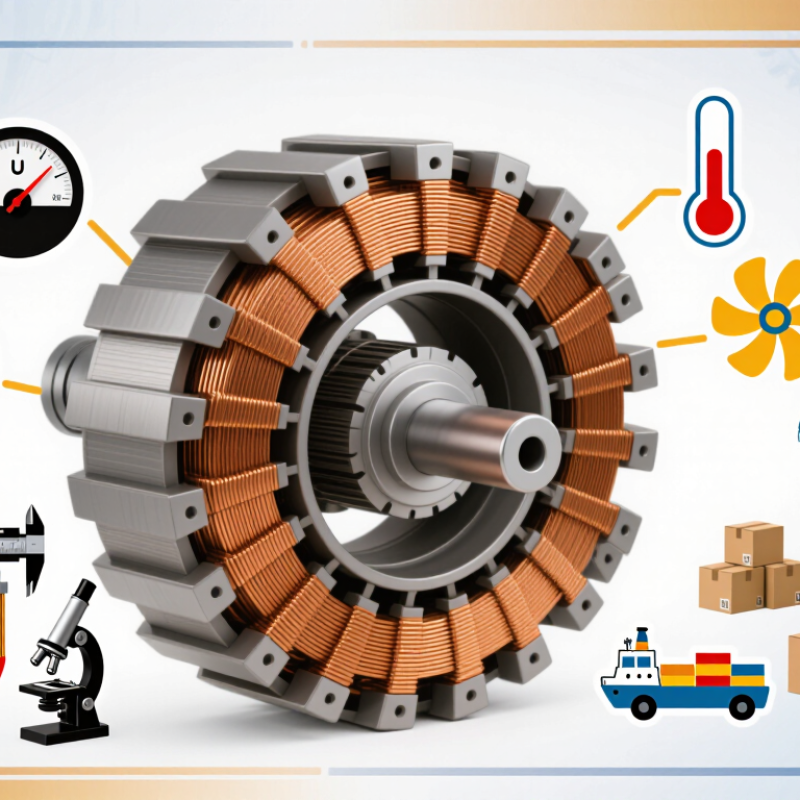
When sourcing a copper wire motor, define its duty before comparing price or efficiency. S1 means continuous running duty under a constant load. The motor must operate long enough to reach thermal equilibrium. IEC 60034-1 provides the framework for this duty classification and rated performance. Check the nameplate carefully. Rated power, voltage, frequency, current, speed, and insulation class should match the application.
Look beyond the copper winding itself. Copper can reduce electrical losses, but poor slot filling, weak insulation, or inadequate cooling can still cause overheating. In practical evaluations, I check temperature-rise test records, winding resistance, and no-load current. The enclosure matters too. A dusty workshop and a clean indoor line require different protection levels. Ambient temperature, installation altitude, starting frequency, and load variation can change the real thermal duty.
Ask the supplier for test conditions, not only headline figures. A motor tested at 25°C may behave differently inside a hot cabinet. Confirm whether the rated output applies continuously at the required voltage and frequency. Review drawings, terminal layouts, bearing details, and spare-part availability before approval. I have seen technically acceptable motors fail because their cooling airflow was blocked after installation. That mistake is easy to miss. A perfect spreadsheet is not enough. Leave room for site verification, because actual operating conditions often expose assumptions made during sourcing.
Specify at least 100% IACS conductivity at 20°C. This equals about 58 MS/m. The resistivity reference is 0.017241 Ω·mm²/m. Use the same temperature for fair comparisons.
“99.9% pure copper” does not prove electrical performance. Impurities, processing, and temper can change conductivity. Purity sounds reassuring. Request measured electrical results instead.
Ask for batch-specific test results, not only a general certificate. Request the heat number, production date, conductivity, resistivity, and equipment details. The report should identify the tested sample and its diameter.
A qualified laboratory should use a four-wire resistance method. The report should record conductor temperature and correction to 20°C. Check diameter carefully. Thicker wire can hide weak conductivity.
Higher resistance increases I²R losses inside the winding slots. Continuous-duty motors may accumulate significant heat from small deviations. Compare resistance with winding length and expected current. A passing test is not permanent proof.
Compare IE2, IE3, IE4, and IE5 classes at rated load. Do not choose from the highest brochure number alone. Rated-load efficiency may differ from partial-load performance. Measure the real duty cycle first.
Confirm rated power, voltage, frequency, speed, enclosure, and cooling method. Also check insulation class, ambient temperature, and service factor. A 400 V, 50 Hz motor may differ on a 460 V, 60 Hz system. Equal conditions matter.
Compare the nameplate with the efficiency test file and incoming records. Where practical, record no-load current, temperature rise, vibration, and loaded input power. One successful sample proves very little. Production variation happens. I once missed a frequency mismatch. That conclusion was incomplete.
Choosing the right Copper Wire Motor for global sourcing requires a structured evaluation of performance, materials, efficiency, and compatibility. Start by defining the motor’s duty cycle and confirm that its S1 continuous rating meets IEC 60034-1 requirements. Copper quality is equally important, so specify winding material with at least 100% IACS conductivity at 20°C to support reliable current flow and heat management.
When sizing the windings, balance current density, copper fill, and allowable temperature rise to achieve stable operation without unnecessary material cost. Compare efficiency at rated load using IEC 60034-30-1 IE2 through IE5 classifications, rather than relying only on no-load figures. Finally, verify global suitability by checking 50/60 Hz operation, IP55 protection, and IEC 60072 mounting dimensions. These steps help buyers select a dependable motor that can perform consistently across different markets and electrical systems.

 Lite Simo